
Corporate Plan 2026-27
Last updated: 31 Aug 2026
The DTA Corporate Plan 2026-27, covers the reporting periods of 2026-27 to 2029–30, as required under paragraph 35 (1)(b) of the Public Governance, Performance and Accountability Act 2013 (PGPA Act). This plan has been prepared in accordance with section 16E of the Public Governance, Performance and Accountability Rule 2014 (PGPA Rule).

We acknowledge the Traditional Owners of Country throughout Australia and celebrate their continuing connection to land, water, culture and community. We pay our respects to Aboriginal and Torres Strait Islander cultures and to Elders past and present.
Wherever you are in Australia, you are on the lands and waters of Australia’s First Peoples.
As the accountable authority of the Digital Transformation Agency (DTA), I present the DTA Corporate Plan 2026-27, which covers the reporting periods of 2026-27 to 2029–30, as required under paragraph 35 (1)(b) of the Public Governance, Performance and Accountability Act 2013 (PGPA Act).
This plan has been prepared in accordance with section 16E of the Public Governance, Performance and Accountability Rule 2014 (PGPA Rule).
Chris Fechner
Chief Executive Officer
31 August 2026
Australia continues to be recognised for its leadership in digital government. In 2025–26, Australia ranked second in the Organisation for Economic Co-operation and Development(OECD's) Digital Government Index and top 5 among the world’s leading digital governments according to the World Bank. Intermedium’s 2026 regional Digital Government Maturity Indicator also ranked the Australian Federal Government first across Australia and New Zealand. These results demonstrate the impact of sustained investment and coordinated effort across the Australian Public Service (APS).
The Digital Transformation Agency (DTA) will build on this momentum by helping agencies adopt Artificial Intelligence (AI) safely and responsibly, strengthen digital and ICT investment outcomes, and design services that work better for people and businesses. Our focus is on the foundations that enable simple, secure and connected services and the workforce capability needed to deliver enduring change.
AI is a significant opportunity for the APS to improve how government works, support public servants and deliver better services. The AI Plan for the APS 2025 provides a clear pathway from experimentation to practical, high-value use. The DTA will equip agencies with the policy, guidance, tools and guardrails needed to realise AI’s benefits safely, transparently and responsibly.
Through our Investment Oversight Framework, our advice will ensure policy objectives are matched with the capabilities needed for success, create public value, and manage risk effectively. This will help government modernise systems, realise the benefits of digital investments, and deliver secure, sustainable, and accessible services.
The success of digital government depends on a capable and adaptable APS workforce. Returning the APS Digital Profession to the DTA will align workforce development with the priorities shaping Australia's digital future. With more than 20,000 members and 14 communities of practice, the profession is a powerful platform for building capability, sharing expertise and supporting digital careers across the public service.
The years ahead will require focus, partnership, and practical delivery. International recognition is welcome, but our measure of success is the difference digital government makes for Australians. By working across government to strengthen capability, improve investment outcomes and accelerate responsible innovation, the DTA will help build a public service that is equipped to deliver for the people it serves.
Chris Fechner
Chief Executive Officer
Digital Transformation Agency
We’re the Australian Government’s trusted advisor on digital and ICT transformation.
Driving a digital government.
Provide strategic and policy leadership, expert investment advice and oversight to drive digital transformation that delivers benefits to all Australians.
Our values guide us in everything we do.
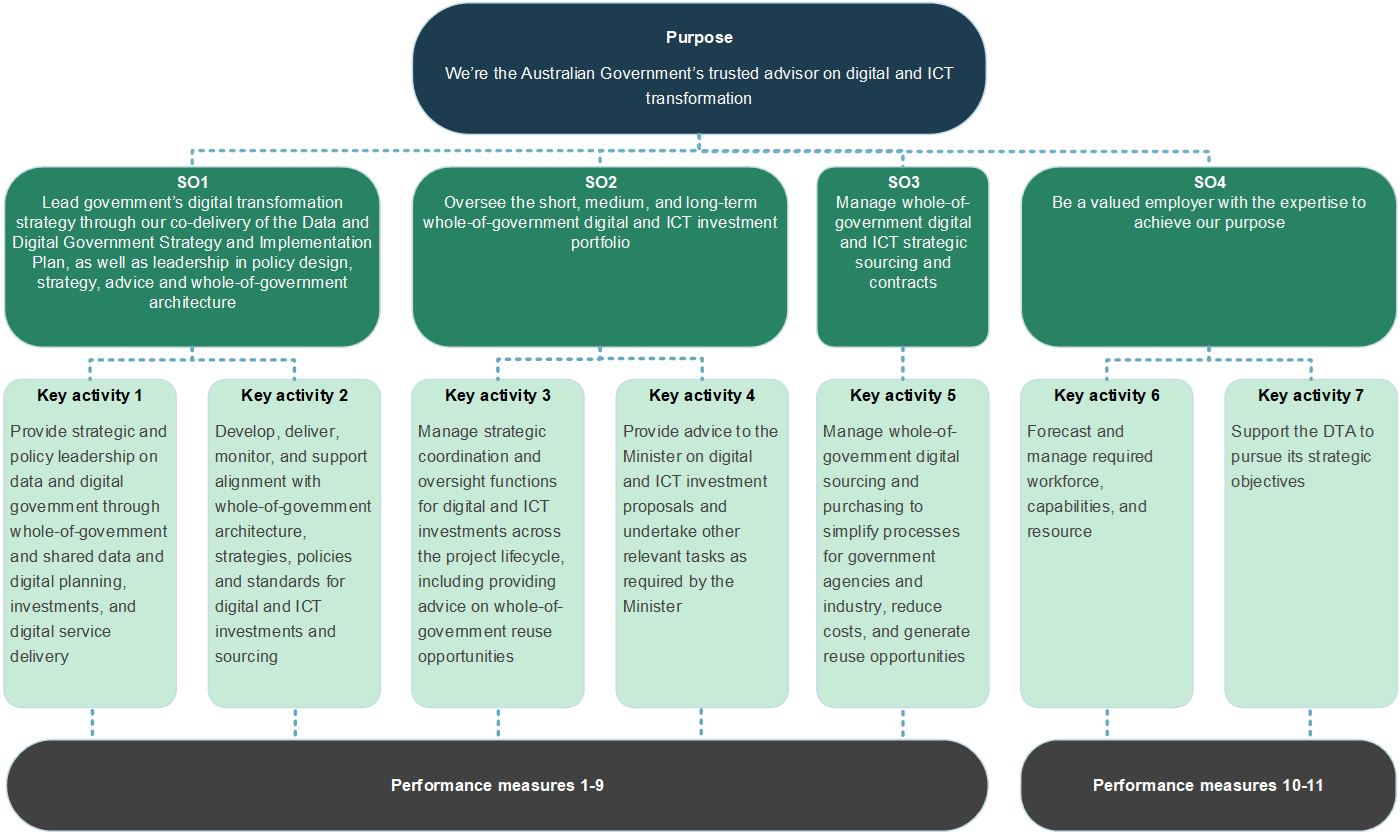
We will achieve our purpose in 2026-27 by focusing our efforts on the following 4 strategic objectives and 7 key activities:
Strategic objective 1
Lead government’s digital transformation strategy through our co-delivery of the Data and Digital Government Strategy and Implementation Plan, as well as leadership in policy design, strategy, advice, and alignment to whole-of-government architecture.
Key activities
- Provide strategic and policy leadership on data and digital government through whole-of-government and shared data and digital planning, investment, and digital service delivery.
- Develop, deliver, monitor and support alignment with whole-of-government architecture, strategies, policies and standards for digital and ICT investments and sourcing.
Strategic objective 2
Oversee the short-, medium- and long-term whole-of-government digital and ICT investment portfolio.
Key activities
- Manage strategic coordination and oversight functions for digital and ICT investments across the project lifecycle, including proving advice on whole-of-government reuse opportunities.
- Provide advice to the Minister on digital and ICT investment proposals and undertake other relevant tasks as required by the Minister
Strategic objective 3
Manage whole-of-government digital and ICT strategic sourcing and contracts
Key activity
- Manage whole-of-government digital sourcing and purchasing to simplify processes for government agencies and industry, reduce costs, and generate reuse opportunities.
Strategic objective 4
Be a valued employer with the expertise to achieve our purpose.
Key activities
- Forecast and manage required workforce, capabilities, and resources.
- Support the DTA to pursue its strategic objectives.
The DTA plays a central role in advancing the Australian Government’s investment in Australia’s digital future. Our operating environment shapes how we perform our role and deliver our functions, purpose and key activities.
The Investment Oversight Framework (IOF) provides government a clear, consistent view of major digital and ICT investments from early planning through to delivery and benefits realisation. It helps agencies shape stronger proposals, align investment decisions with whole-of-government priorities, and manage delivery risks before they affect outcomes for people, businesses and public servants.
Through the IOF, the DTA connects strategy, policy, architecture and investment advice. This supports clearer links between policy intent, digital capability, delivery readiness and measurable benefits.
In August 2025, the IOF was recognised by the Organisation for Economic Co-operation and Development (OECD) as a leading practice model for digital investment governance, reinforcing Australia’s strong international leadership in the oversight of digital and ICT investments.
In 2026–27, our focus will be on making the IOF more connected, practical and evidence-based. We will continue to mature the IOF as a strategic investment and assurance capability, drawing on data, insights and portfolio analysis to inform advice to government and improve consistency across the investment lifecycle. This approach will support agencies to consider reuse, interoperability, cyber security, privacy, sustainability and accessibility from the outset.
Building on our structured approach to investment planning, we will continue to refine assurance mechanisms and guidance to support complex whole-of-government priorities and respond to an evolving technology landscape. Together, these measures will help ensure digital investments across the government remain resilient and aligned with the Data and Digital Government Strategy.
AI presents a significant opportunity to improve government productivity, strengthen public administration and deliver better services for Australians. At the same time, rapid developments in generative and agentic AI bring new considerations for governance, safety, privacy, cyber security, transparency and accountability.
The DTA leads and supports the responsible, innovative and scalable adoption of AI across the APS. Our whole-of-government role brings together policy leadership, governance and practical guidance to enable safe, ethical and effective AI adoption. In 2025-26, the DTA released the Agentic AI addendum to the AI technical standard for Australian Government highlighting the best practices and key considerations for the secure and governed implementation of agentic AI systems.
In 2026-27, we will continue implementing the Policy for the responsible use of AI in government through practical guidance and compliance monitoring. Insights from AI use cases will inform ongoing evaluation of the policy’s effectiveness to ensure it remains fit-for-purpose and responsive to the evolving technology. Additionally, the AI Review Committee and the AI Impact Assessment Tool will be further developed to help agencies identify, assess and manage risks associated with AI use.
The APS AI Plan will guide further work on, practical architecture, technical safety, testing and implementation guidance. This will support greater consistency, interoperability and reuse across government, while helping agencies manage emerging risks and avoid fragmented or bespoke approaches to AI adoption.
Building AI capability across the APS remains a priority, supported by learning products, implementation resources, stakeholder forums and cross-government engagement. Monitoring domestic and international developments, alongside engagement with government, industry, academia and international partners, will help ensure Australia's approach to AI remains contemporary, responsible and aligned with community expectations.
Our people are our most important asset, and the DTA’s APS Employee Census results reflect a workforce an engaged, committed workforce focused on delivering the government’s digital transformation priorities.
The DTA brings together expertise across:
As the digital landscape continues to evolve, maintaining the skills and expertise required to respond to emerging opportunities and risks remains a priority. This includes AI capability, digital architecture, investment assurance and whole-of-government policy. Targeted recruitment, professional development and knowledge sharing will ensure we have the expertise required to deliver strategic advice, effective oversight and practical support across government.
Our investment in people extends beyond our own workforce. Building digital capability across the APS is an important extension of our investment in people. With the APS Digital Profession’s return to the DTA, we help build digital capability across government and support a skilled, adaptable and future-focused public sector workforce equipped to deliver high-quality digital services and outcomes for Australians.
Maintaining core capability within the APS is also an important part of this approach. The DTA operates in line with the APS Strategic Commissioning Framework. Core work is generally performed in-house, with outsourcing limited to the circumstances permitted under the Framework. In 2026-27, the DTA will further embed the Framework and strengthen our workforce capability within available resources.
The DTA will continue to build a workplace where all employees feel respected, included and able to contribute. This will be supported through activities that strengthen awareness, participation and capability across the agency, including recognising key cultural events, sharing learning opportunities, and providing access to internal and external development programs.
Inclusion will remain a core consideration in workforce planning, people initiatives and recruitment practices. Employees will continue to have opportunities to develop their skills and progress their careers, while our partnership with the Australian Disability Network will support improvements to recruitment accessibility, including work towards achieving Disability Confident Recruiter status.
A key priority for the coming year is the finalisation and implementation of the DTA’s second Innovate Reconciliation Action Plan (RAP). Informed by staff engagement and feedback, the RAP will set out practical actions to support reconciliation and contribute to the Closing the Gap Priority Reforms. Executive leaders will play an active role in delivering these commitments and embedding reconciliation considerations across the agency. Staff will also have opportunities to deepen their understanding of First Nations cultures, perspectives and experiences.
Demonstrating our values through visible leadership and everyday behaviours will remain central to fostering an inclusive workplace culture. Senior leaders will be encouraged to participate in diversity, inclusion and reconciliation initiatives throughout the year, while ongoing engagement with employee networks, staff and external partners will ensure our approach remains relevant, informed and effective.
The DTA will continue to strengthen employment and development opportunities for groups underrepresented in the APS, including Aboriginal and Torres Strait Islander peoples, people with disability, and people from culturally and linguistically diverse backgrounds. These efforts support a workforce that reflects the diversity of the Australian community and strengthens the DTA's ability to design, deliver and advise on digital services that meet the needs of all Australians.
Integrity is deeply important to our work in the APS. It underpins the trust of the Australian public, who rely on us to serve their interests and deliver the best outcomes for Australia.
The DTA’s integrity framework builds on the DTA values and behaviours, emphasising transparency, excellence and respect. As a trusted advisor to the government, our values and behaviours not only reflect our mandate but also play a crucial role in shaping an effective integrity framework. They serve as the foundation for our daily work practices and guide us in all aspects of our work, both within the DTA and across the APS.
In fulfilling our purpose, we have made significant efforts to embed AI responsibly and strategically across the DTA. Building on this, our focus in 2026-27 will be on advancing innovation and strengthening our leadership in the secure, transparent and responsible use of AI across government.
Foundational capability has also been established to connect data across the IOF through an Integrated Data Platform (IDP). The IDP is transforming how the DTA manages investment oversight, centralising data, improving reporting and assurance and enabling end-to-end visibility of the investment lifecycle. Underpinned by strong data governance, record level security, and the Data and Digital Government Strategy, the IDP will continue to evolve in 2026-27 to strengthen investment oversight and decision making.
Our continued development of digital.gov.au is strengthening its role as a central source of digital government information. Designed to showcase digital government initiatives and connect users to relevant information, including the Australian Government Architecture website, digital.gov.au has continued to attract growing stakeholder interest. In 2026-27, we will continue to expand and enrich its content to increase its value across government and ensure it remains responsive to user needs. Together, these initiatives support the DTA’s broader digital transformation, modernising internal systems, uplifting data literacy and building a scalable and secure digital architecture.
As part of this transformation, the DTA is also progressing its Enterprise Resource Planning (ERP) transformation to modernise core corporate systems and strengthen the way we manage finance, procurement, people and enabling services. The ERP will enable more consistent processes, improved data quality, stronger reporting, and greater integration across internal business functions. As the capability matures, it will provide a stronger foundation for evidence-based decision-making, operational efficiency and future digital service improvements.
Cyber security, information management and privacy are critical to this transformation and to maintaining trust in digital government. We will continue to strengthen cyber resilience through contemporary security controls, monitoring and assurance; mature information management practices so records, decisions and corporate knowledge are reliable and discoverable; and embed privacy-by-design principles across data, systems and process improvements. Together, these disciplines ensure our digital, ERP and data initiatives are secure, well-governed and aligned with public sector obligations.
Collectively, these initiatives will strengthen how we operate as one agency and deliver greater value to government. By embedding responsible innovation, strong governance and secure digital foundations, the DTA will continue to demonstrate digital leadership in practice, both within our organisation and through our support for a more connected, data-driven public sector.
We are committed to identifying and minimising risk, while seizing opportunities to ensure we achieve our strategic objectives. Our approach balances appropriate controls and mitigation with timely, efficient and cost-effective delivery. Regular, open and transparent communication with stakeholders enables us to identify, understand and respond to emerging risks.
This approach is underpinned by the AS/NZS 31000:2018 risk management standard and the Commonwealth Risk Management Policy (RMG 211), supporting the requirements of section 16 of the PGPA Act.
Our Audit and Risk Committee provides independent advice to our CEO on the appropriateness of our systems of risk oversight and management and internal control.
Alongside these governance arrangements, we actively monitor emerging risks and opportunities arising from digital transformation, cyber security, data, technology and artificial intelligence. This enables us to anticipate and respond to change while supporting the delivery of secure, trusted and effective government services.
Risk management is embedded in the DTA’s broader planning, governance and performance arrangements. Our Risk Management Framework, Risk Management Policy and Risk Appetite Statement set out the DTA’s approach to informed risk-taking and support effective decision-making to achieve our objectives and outcomes.
We take a measured approach to risk, as articulated in our risk appetite statement:
“The DTA adopts a measured approach to risk. In support of its mandate to provide strategic and policy leadership and expert investment advice to drive government digital transformation, the DTA is willing to accept higher levels of risk where there is clear opportunity to realise benefits and where risks can be effectively managed. The DTA is less willing to accept risk where benefits are uncertain or where risks cannot be managed to acceptable levels, including in relation to work health and safety, fraud and corruption and financial compliance.”
The following table provides a summary of our strategic risks and how we manage them.
| Strategic risks | Management of the risk |
|---|---|
| The DTA fails to deliver the government’s priorities and the DTA’s mandate |
|
| The work of the DTA is not seen by other agencies as providing effective and transparent advice on digital |
|
| The BuyICT platform and/or whole-of-government agreements are not delivering value for buyers and sellers |
|
| The DTA is unable to meet operational requirements now and into the future |
|
| The DTA fails to keep pace with the rapid evolution of AI capabilities, reducing the relevance and currency of its policies, standards and advice, and constraining its ability to manage downstream impacts from Strategic risks 1 and 2 |
|
| The DTA fails to manage staffing and financial resources within required budget constraints |
|
We work closely with Australian Government departments and agencies.
We also work with state, territory and international governments, advisory and oversight bodies, as well as industry and academia, and with people who provide or use government services.
We work collaboratively with our stakeholders across government and industry to understand the operating environment, identify challenges and opportunities for improvement, and provide trusted advice to government. Our advice influences and shapes whole-of-government digital services, policies and standards and strengthens oversight arrangements for digital and ICT investments across the Australian Government.
We use the IOF and the DTA’s Management Framework to support communication and collaboration internally and with our external partners, setting clear expectations for the direction of digital government. As an agency with a whole-of-government leadership, coordination and advisory role, the DTA must be an exemplar in working effectively with and through our partners.
The DTA is responsible for leading the overarching direction for digital strategy, policy, and services, while being independent of its delivery. This means the benefits (impact) are often delivered by other agencies. The DTA’s performance measures assess our contribution to the impact, rather than assess the impact itself.
Our performance measures relate directly to our strategic objectives and key activities. For 2026-27 and the forward years, the DTA will continue to measure performance against the performance measures introduced in 2024-25 with adjustments to 4 performance measures that better reflect the DTA’s role and contribution. Details of these changes, compared to the 2026-27 Portfolio Budget Statements are provided at Appendix A.
The measurement and assessment of these performance measures will be published in our 2026–27 annual performance statements.
An overview of our performance framework to map our purpose, strategic objectives, key activities and performance measures is provided in the diagram.
| Performance measure 1 | |
|---|---|
| Measure | The rate of agency adoption of, and compliance with, the DTA's digital transformation strategies, policies, standards and whole-of-government architectures |
| Target |
2026-27: Baseline established for agency adoption and compliance 2027-28: Improvement against baseline 2028-29: Sustained improvement or maintained strong performance against baseline 2029-30: Matured adoption and compliance trend |
| Rationale |
This measure assesses the DTA’s effectiveness in driving whole-of-government adoption of, and compliance with, its digital transformation strategies, policies, standards and whole-of-government architectures. It reflects the DTA’s role as a steward of the digital transformation agenda. It uses the rate of agency adoption and compliance to assess the extent to which DTA leadership, guidance and whole-of-government architecture are influencing agency behaviour and implementation. It also supports learning and continuous improvement by identifying where adoption is strong and where further effort may be required. |
| Methodology | DTA assessment and analysis of in-scope agencies that have adopted, and are compliant with, nominated DTA strategies, policies, standards or whole-of-government architectures during the reporting period |
| Data Source | Internal records and DTA assessments |
| Measure Type | Qualitative, Effectiveness |
| Related key activities | 1 and 2 |
| Changes since last period | Yes, refer to Appendix A |
| Performance measure 2 | |
|---|---|
| Measure | Percentage of digital investments identified by the DTA as in-scope for the Digital and ICT IOF which have an agreed assurance plan in place |
| Target | 2026-27 and forward years: 80% |
| Rationale | The Assurance Framework for Digital and ICT Investments requires the Government’s digital and ICT-enabled investments to plan for and implement assurance activities that are fit for purpose to maximise their chance of success. The DTA works closely with agencies to ensure Assurance Plans that meet the requirements of the framework are developed, agreed with the DTA and implemented to ensure the assurance information required to inform government decisions about that investment. |
| Methodology | DTA review of internal data and records on digital investments with agreed assurance plans and digital investments that are in scope of the IOF |
| Data Source | Internal records and database |
| Measure Type | Quantitative, Effectiveness |
| Related key activities | 3 |
| Changes since last period | No |
| Performance measure 3 | |
|---|---|
| Measure | Percentage of significant investment proposals that have implemented DTA’s recommendations to use appropriate DCM (Domain and Capability Model) categorisation as per the AGA |
| Target | 2026-27 and forward years: 75% |
| Rationale |
This performance measure tracks the percentage of significant new government digital investment proposals that are aligned and supported by the relevant AGA digital capabilities and integrated into the IOF. Consistently identifying digital capabilities ensures that guardrails are applied so that digital solutions are interoperable, reusable and aligned to the government’s digital agenda, while reducing risk and maximising value for money. |
| Methodology | DTA review of internal data on digital investment proposals |
| Data Source | Internal records and database |
| Measure Type | Qualitative, Effectiveness |
| Related key activities | 2 and 3 |
| Changes since last period | No |
| Performance measure 4 | |
|---|---|
| Measure | The extent to which the DTA’s strategic advice and portfolio insights enable informed government investment decisions during the Budget and Mid-Year Economic and Fiscal Outlook (MYEFO) cycles |
| Target |
2026-27: Baseline established 2027-28: Improvement against baseline 2028-29: Sustained improvement or maintained strong performance against baseline 2029-30: Matured effectiveness trend supported by comparable evidence across cycles |
| Rationale |
This measure assesses the effectiveness of the DTA’s Digital Investment Overview (DIO) in enabling informed government investment decisions during Budget and MYEFO cycles. The DIO is a key component of the Investment Oversight Framework. It provides early whole-of-government visibility of major digital and ICT investment proposals and supports clearer decision-making about investments. |
| Methodology | Review of DTA data around timeliness, usefulness and influence through internal records and stakeholder feedback where applicable |
| Data Source | DIO data collection records, assessments, related artefacts and stakeholder feedback where applicable |
| Measure Type | Qualitative, Effectiveness |
| Related key activities | 1, 2 and 4 |
| Changes since last period | Yes, refer to Appendix A |
| Performance measure 5 | |
|---|---|
| Measure | The extent to which the DTA’s strategic advice and portfolio insights enable informed government investment decisions during the Budget and Mid-Year Economic and Fiscal Outlook (MYEFO) cycles |
| Target |
2026-27: Baseline established 2027-28: Improvement against baseline 2028-29: Sustained improvement or maintained strong performance against baseline 2029-30: Matured effectiveness trend supported by comparable evidence across cycles |
| Rationale |
This measure assesses the effectiveness of the DTA’s Digital Investment Overview (DIO) in enabling informed government investment decisions during Budget and MYEFO cycles. The DIO is a key component of the Investment Oversight Framework. It provides early whole-of-government visibility of major digital and ICT investment proposals and supports clearer decision-making about investments. |
| Methodology | Review of DTA data around timeliness, usefulness and influence through internal records and stakeholder feedback where applicable |
| Data Source | DIO data collection records, assessments, related artefacts and stakeholder feedback where applicable |
| Measure Type | Qualitative, Effectiveness |
| Related key activities | 1, 2 and 4 |
| Changes since last period | Yes, refer to Appendix A |
| Performance measure 6 | |
|---|---|
| Measure | Average score from stakeholders on the quality and timeliness of advice provided by the DTA in the assessment of their digital investment proposal |
| Target | 2026-27 and forward years: 85% |
| Rationale | Agencies bringing forward digital and ICT proposals are required to engage with the DTA prior to Cabinet consideration to enable the DTA to assess the proposal to ensure it is robust and meets whole-of-government digital standards. At the end of each Budget and MYEFO process, the DTA surveys stakeholders for feedback on their experience engaging with the DTA on the proposal. The scores from the survey are used to measure stakeholder satisfaction with the quality and timeliness of DTA advice. |
| Methodology | Stakeholder survey and stakeholder feedback where applicable |
| Data Source | Stakeholder surveys received from external entities |
| Measure Type | Quantitative, Efficiency and Effectiveness |
| Related key activities | 2 and 3 |
| Changes since last period | No |
| Performance measure 7 | |
|---|---|
| Measure | Percentage of agencies who report overall satisfaction with their experience engaging with DTA marketplaces and panels |
| Target | 2026-27 and forward years: 75% |
| Rationale |
The DTA provides the establishment, education, training and access to the panels, marketplaces and arrangements in BuyICT.gov.au. This platform and the procurement arrangements, panels and marketplaces within BuyICT.gov.au, directly influence how government purchases. Feedback obtained through regular surveys of users on BuyICT.gov.au allows tracking of how the DTA is progressing towards strategic objective 3. |
| Methodology | Review of DTA data, stakeholder survey and stakeholder feedback |
| Data Source | BuyICT.gov.au agency feedback surveys, customer service feedback received from government agencies, agency engagement and user research activities relating to DTA marketplaces, panels and whole-of-government digital sourcing arrangements, and government use of DTA arrangements, marketplaces and panels |
| Measure Type | Quantitative, Effectiveness |
| Related key activities | 5 |
| Changes since last period | Yes, refer to Appendix A |
| Performance measure 8 | |
|---|---|
| Measure | Percentage of at-risk projects receiving support from the DTA in applying the escalation protocols under the Assurance Framework for Digital and ICT Investments (including support at the ‘triage’ stage) |
| Target |
2026-27: 70% Forward years: 80% |
| Rationale |
Assurance escalation protocols focus on supporting agencies in the timely resolution of delivery challenges experienced by their investments, as well as keeping ministers and senior leaders informed of underperforming digital investments. This measure reflects the DTA’s work in supporting at-risk digital projects and improving the Australian Government’s overall digital portfolio performance. |
| Methodology | Review of DTA data on projects initially funded since the assurance system was introduced in November 2021 |
| Data Source | Internal records and database |
| Measure Type | Quantitative, Output |
| Related key activities | 1,2 and 3 |
| Changes since last period | No |
| Performance measure 9 | |
|---|---|
| Measure | Percentage of participants in training for Senior Responsible Officials who report increased confidence to successfully lead a digital investment following completion of DTA’s Digital Governance Program (i.e. SRO training program) |
| Target | 2026-27 and forward years: 80% |
| Rationale |
The DTA’s Digital Governance Program caters to Senior Responsible Officials (SROs) and executive leaders across the Australian Government who are accountable or responsible for the successful delivery of government digital projects. Ministers and agency heads will benefit from their policy initiatives having a cohort of digital leaders better equipped to lead digital projects successfully. This measure reflects the DTA’s work focus to uplift the capabilities of digital projects leaders across the APS, ensure ensuring SROs and senior leaders are better equipped to avoid stretching the capabilities of APS leaders and reducing the risk of project failure. |
| Methodology | Review of DTA data from evaluation surveys and stakeholder feedback where applicable |
| Data Source | Training evaluation surveys |
| Measure Type | Quantitative, Effectiveness |
| Related key activities | 2 and 3 |
| Changes since last period | Yes, refer to Appendix A |
| Performance measure 10 | |
|---|---|
| Measure | Positive rating from staff to the agency’s APS Census to: ‘My workgroup has the appropriate skills, capabilities and knowledge to perform well’ |
| Target | 2026-27 and forward years: 80 or above |
| Rationale | This measure provides a basis that is objective and unbiased from the annual APS Census outcomes (quantitative) and reflects the effectiveness and efficiency of DTA’s progress in achieving the strategic objective of being a valued employer with the expertise to achieve our purpose. |
| Methodology | Results from the APS Census question “My workgroup has the appropriate skills, capabilities and knowledge to perform well” |
| Data Source | Annual APS Census results |
| Measure Type | Quantitative, Effectiveness |
| Related key activities | 6 and 7 |
| Changes since last period | No |
| Performance measure 11 | |
|---|---|
| Measure | Percentage of initiatives on the DTA’s internal data and digital strategy and roadmap which are either delivered or on track |
| Target |
2026-27: 85% Forward years: 90% |
| Rationale |
The DTA’s internal data and digital strategy include an investment roadmap with specific initiatives. Each of these initiatives is a DTA-owned or DTA-led project, or a DTA contribution to an external deliverable. This measure reflects the DTA’s continuous implementation of its internal data and digital strategy. |
| Methodology | Review of DTA internal data and digital strategy roadmap and calculation |
| Data Source | Internal records and database |
| Measure Type | Quantitative, Output |
| Related key activities | 6 and 7 |
| Changes since last period | No |
The table below provides a description of changes made to the performance measures in this corporate plan, in comparison to the 2025-26 Corporate Plan and the 2026-27 Portfolio Budget Statements.
| Number | Performance measure in 2026-27 Portfolio Budget Statement / 2025-26 Corporate Plan | Performance measure in Corporate Plan 2026-27 | Status | Description of change for Corporate Plan 2026-27 |
|---|---|---|---|---|
| 1 | Annual review to measure the influence and impact of the DTA’s leadership of the digital transformation agenda through the Data and Digital Government Strategy (DDGS) | The rate of agency adoption of, and compliance with, the DTA's digital transformation strategies, policies, standards and whole-of-government architectures | Revised measure | The revised measure better reflects the value of the DTA in driving meaningful change through the Data and Digital Government Strategy. |
| 5 | Digital Investment Overview prepared and submitted to government for Budget and Mid-Year Economic and Fiscal Outlook (MYEFO) cycles | The extent to which the DTA’s strategic advice and portfolio insights enable informed government investment decisions during the Budget and Mid-Year Economic and Fiscal Outlook (MYEFO) cycles | Revised measure | The revised measure better reflects the Digital Investment Overview’s role in providing early whole-of-government visibility of major digital and ICT proposals and the value of the DTA in shaping investment advice. |
| 7 | Percentage of buyers and sellers participating in the DTA’s marketplaces who report it was easy or very easy to complete their task on BuyICT. | Percentage of agencies who report overall satisfaction with their experience engaging with DTA marketplaces and panels. | Revised measure | The revised measure is aimed at measuring the DTA ‘s value in meeting the needs of users of the DTA’s arrangements, panels and marketplaces. |
| Number | Performance measure in 2026-27 Portfolio Budget Statement / 2025-26 Corporate Plan | Performance measure in Corporate Plan 2026-27 | Status | Description of change for Corporate Plan 2026-27 |
|---|---|---|---|---|
| 9 | Percentage of participants in training for Senior Responsible Officials who report increased confidence in contributing effectively on a governance board for a digital investment following completion of the Senior Responsible Official (SRO) training program. | Percentage of participants in training for Senior Responsible Officials who report increased confidence to successfully lead a digital investment following completion of DTA’s Digital Governance Program (i.e. SRO training program) | Revised measure | The revised measure wording reflects the leadership role of Senior Responsible Officers in a digital investment, and the DTA’s focus to uplift the capabilities of digital project leaders across the APS. |
The Corporate Plan has been prepared in accordance with the requirements of:
The table details the requirements met by the DTA’s Corporate Plan and the page reference(s) for each requirement.
| Requirements | Page(s) |
|---|---|
|
Introduction
|
3-4 |
| Purposes | 5 |
| Key activities | 6-7 |
|
Operating context
|
8-16 |
| Performance | 17-29 |